How Mobile Notification Timing Shapes Session Length Patterns in Virtual Table Games
Virtual table games such as online poker, blackjack and roulette continue to attract frequent participants who engage through mobile platforms, and researchers have tracked how push notification timing correlates with changes in average session durations. Data from multiple markets shows that notifications sent during specific windows extend or compress play periods depending on user routines, with patterns emerging across different time zones and demographic groups.
Core Patterns in Notification Delivery and User Response
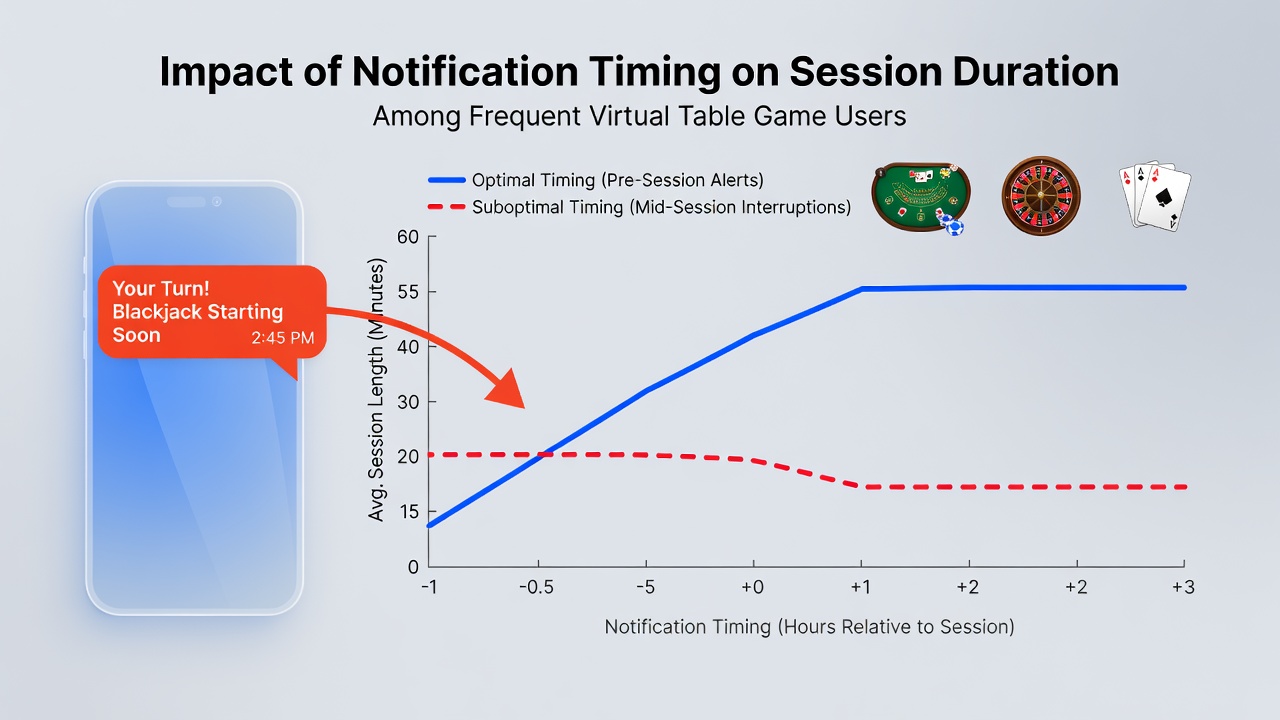
Studies conducted on major iGaming operators reveal that messages arriving between 6 PM and 10 PM local time often coincide with session extensions of 25 to 40 minutes among frequent players, while early morning alerts between 7 AM and 9 AM tend to produce shorter bursts lasting under 15 minutes. These differences arise because evening notifications align with leisure periods when participants have already completed daily tasks, whereas morning messages interrupt work or commute schedules and prompt quicker logouts.
Operators segment their user bases by historical activity logs, then schedule reminders about table openings or bonus expirations to match those established rhythms. One analysis of Canadian provincial data from 2025 indicated that participants receiving three or more evening notifications per week recorded median sessions 18 percent longer than those who received equivalent messages during daytime hours.
Regional Data and Platform Adjustments Observed in 2026
By August 2026, several European and North American operators had refined their notification engines using aggregated telemetry from millions of sessions. Figures released by the Australian Gambling Research Centre show that table game players who received staggered alerts spaced at least 90 minutes apart maintained sessions averaging 47 minutes, compared with 31 minutes for those receiving clustered notifications within 30-minute windows.
Canadian regulators tracking Ontario’s iGaming market noted similar trends, where push timing influenced repeat logins within the same day. Participants who received an initial evening alert followed by a mid-session update often extended play by an additional 12 to 20 minutes before voluntarily exiting. These measurements came from anonymized session logs submitted by licensed platforms and cross-referenced with device timestamp data.
Behavioral Factors That Interact With Timing
Frequent participants exhibit distinct response curves based on notification content and delivery hour. Alerts highlighting new table stakes or limited-time tournaments generate stronger engagement when sent after 8 PM, while generic login reminders produce weaker effects regardless of hour. Observers note that players who have already completed two or more sessions in a single day show reduced sensitivity to additional messages, suggesting habituation plays a measurable role.
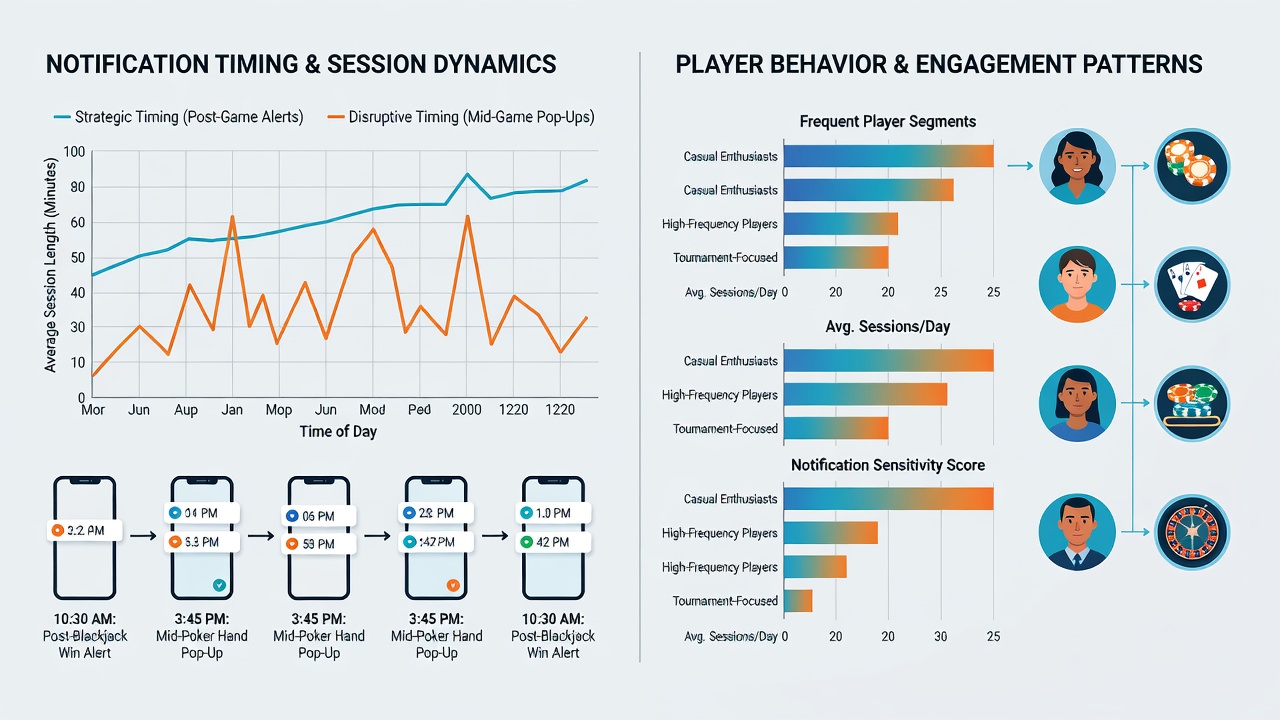
Platform algorithms now incorporate real-time location data and historical engagement scores to predict optimal send times for each individual. A report prepared for the Nevada Gaming Control Board in early 2026 documented that operators using these predictive models achieved a 9 percent reduction in very short sessions under 10 minutes, which operators associate with lower retention risk.
Measurement Challenges and Data Sources
Quantifying exact causation remains difficult because external variables such as concurrent promotions, device battery levels and competing app notifications also affect user availability. Researchers therefore rely on large-scale A/B testing frameworks that hold content constant while varying only delivery time. Results from these controlled experiments consistently point to evening windows as the strongest predictors of extended play among dedicated virtual table game users.
Industry reports compiled by the European Gaming and Betting Association further indicate that cross-border players in multiple time zones respond differently when notifications are localized versus sent according to a single global schedule. Localized timing produced more consistent session lengthening across regions, whereas global schedules created variance of up to 15 minutes in median duration depending on the recipient’s offset from the operator’s headquarters time zone.
Conclusion
Available evidence demonstrates that mobile notification timing functions as a measurable variable in session length patterns for frequent virtual table game participants. Operators continue to refine delivery schedules using regional data sets and behavioral telemetry, while regulatory bodies in multiple jurisdictions collect anonymized metrics that allow ongoing comparison across markets. These documented relationships between timing and duration provide operators and researchers with concrete parameters for future platform adjustments.