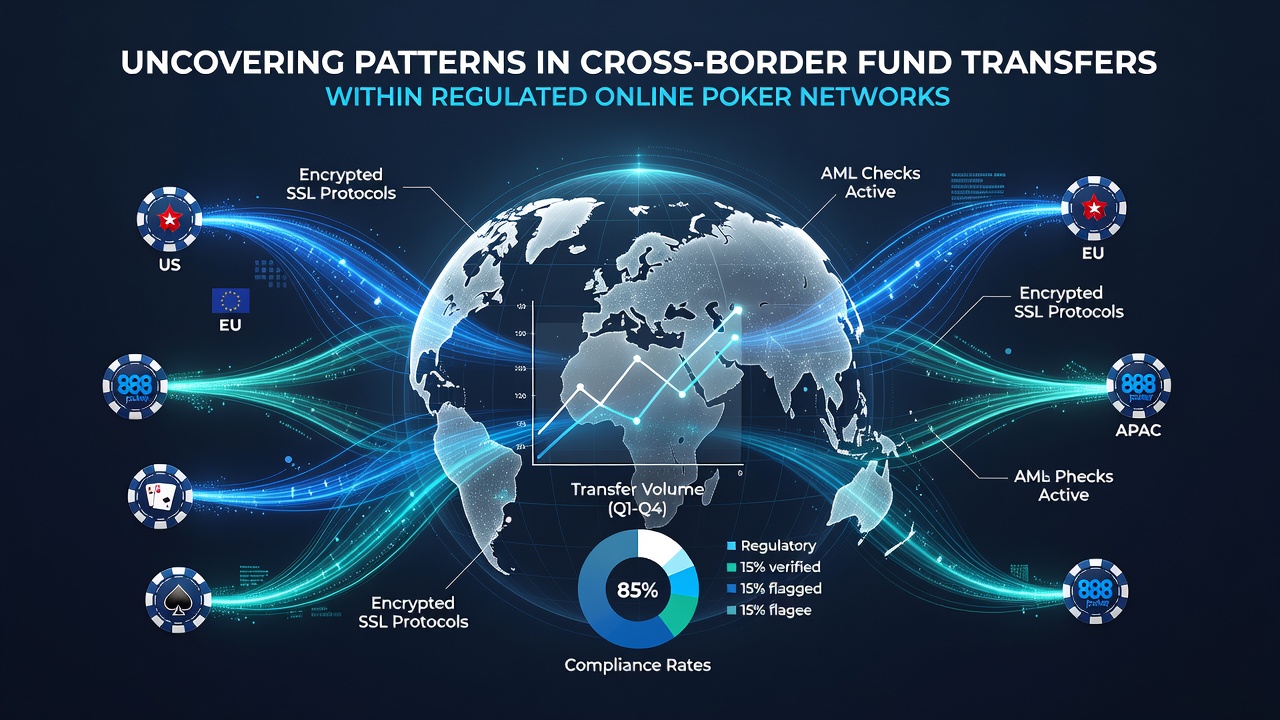
Uncovering Patterns in Cross-Border Fund Transfers Within Regulated Online Poker Networks
Regulated online poker networks handle millions of cross-border transactions each month, and financial oversight bodies track these movements to identify recurring structures. Data compiled through anti-money laundering systems shows that transfers between European Union member states and North American operators follow distinct seasonal cycles, with volume spikes often aligning to major tournament schedules. Observers note that operators in jurisdictions such as New Jersey and Ontario maintain detailed ledgers that feed into shared reporting platforms, allowing regulators to map fund pathways without disrupting player activity.
Regulatory Oversight Structures Across Regions
Multiple agencies coordinate their monitoring efforts, and the U.S. Financial Crimes Enforcement Network requires operators to file currency transaction reports once thresholds are crossed. Similar obligations exist under Canadian provincial frameworks, where the Alcohol and Gaming Commission of Ontario collects transaction metadata from licensed sites. In Australia, AUSTRAC receives parallel filings that cover poker network activity involving Australian residents, creating a three-continent data set that analysts cross-reference for anomalies. These overlapping requirements produce consistent fields such as originating wallet identifiers, destination accounts, and timestamps, which researchers aggregate to detect repeated corridors.
Observed Transfer Corridors and Volume Trends
Analysis of aggregated records reveals that the largest share of cross-border poker-related movements travels between the United States and several EU countries, particularly Malta and Estonia, where many licensed platforms maintain their primary banking relationships. A secondary corridor runs between Canadian provinces and the United Kingdom, although volumes on this route have fluctuated since 2024 as operators adjusted to new licensing rules. Figures released in July 2026 by FinCEN indicated that average monthly transfer sizes on the U.S.-EU corridor rose 12 percent year-over-year, while same-day settlement rates increased from 68 percent to 74 percent across monitored networks.
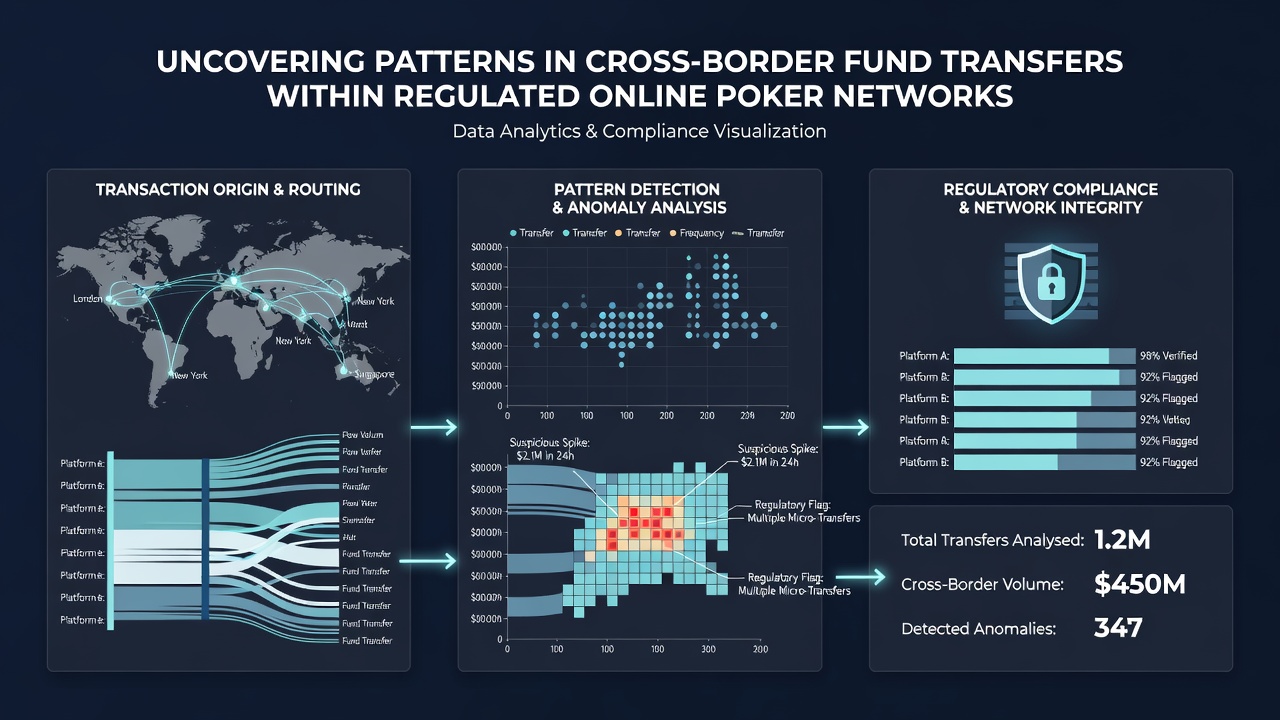
Those who study these datasets point out that micro-transfers under 500 dollars account for the majority of individual movements yet represent only a modest portion of total value. Larger lump-sum withdrawals, by contrast, concentrate on weekends following major online series, creating predictable peaks that compliance teams now flag automatically. Researchers have documented that players who maintain accounts in multiple regulated networks tend to route smaller amounts through one corridor while consolidating winnings through another, a behavior that appears in roughly 8 percent of high-activity accounts according to internal operator audits shared with regulators.
Detection Methods and Data Integration
Modern monitoring platforms combine on-chain analytics with traditional banking feeds, and several networks have adopted machine-learning models trained on three years of labeled transaction histories. These models assign risk scores based on velocity, geographic mismatch, and deviation from a player's established pattern. When scores exceed internal thresholds, operators generate alerts that reach both internal compliance teams and the relevant regulatory body within the same business day. The approach has reduced false positives by approximately 22 percent compared with rule-based systems still used by some smaller platforms, according to a 2025 industry benchmarking report.
Integration between jurisdictions remains uneven, yet progress continues through bilateral data-sharing agreements. Canadian and U.S. regulators exchange standardized reports on a monthly basis, while Australian authorities participate in a separate arrangement focused on Asia-Pacific corridors. These exchanges allow analysts to reconstruct multi-hop transfers that would otherwise appear fragmented when viewed from a single jurisdiction.
Recent Developments in July 2026
July 2026 brought updated reporting templates from both FinCEN and AUSTRAC that require additional fields for virtual asset service providers involved in poker network settlements. Early submissions under the new templates show an increase in transfers routed through licensed stablecoin gateways, particularly those domiciled in Singapore and the Cayman Islands. Regulators report that these gateways now handle roughly 15 percent of cross-border poker settlements on monitored networks, up from 9 percent in the first quarter of the year. The shift has prompted several operators to implement real-time wallet screening that checks addresses against sanctions lists before crediting player accounts.
Conclusion
Cross-border fund transfers within regulated online poker networks continue to generate structured data sets that oversight bodies use to refine detection capabilities. Consistent reporting standards across the United States, Canada, and Australia have enabled clearer mapping of corridors and volume trends, while technological upgrades have improved the precision of risk scoring. As additional jurisdictions adopt similar requirements, the granularity of available information is expected to increase further, supporting ongoing efforts to maintain transparent and compliant payment flows.